An eviction notice Dubai landlords can rely on must be in writing and served through a notary public or by registered post: at least 12 months before the eviction date to end a lease at expiry for one of four reasons (a sale, the owner or a first-degree relative moving in, demolition, or major renovation), or during the lease for a listed breach, such as rent still unpaid 30 days after a notice to pay. Those rules are in Article 25 of Law No. 26 of 2007, as amended by Law No. 33 of 2008. The notice doesn't evict anyone by itself: if the tenant stays, the landlord files an eviction claim at the Rental Disputes Center (RDC), and the tenant keeps paying rent until a judgment is enforced (Article 31).
- 12 months, at the end of the lease: sale, own or family use, demolition, or comprehensive maintenance, each with its own proof.
- 30 days, during the lease: rent unpaid or another obligation not met after a notice; other serious breaches need a notice too.
- No reason, no eviction: a landlord can't end a lease at expiry just by declining to renew.
- Cost: AED 300 for one landlord's notice at a Dubai Courts notary; an RDC eviction claim is 3.5% of the annual rent (AED 500 to AED 20,000) plus AED 120.
What is an eviction notice in Dubai?
An eviction notice in Dubai is the landlord's formal written warning that the RDC requires before it hears an eviction claim. It must give the reason and, for an end-of-lease eviction, the eviction date, and it must reach the tenant through a notary public or registered post. People often call it a RERA eviction notice, but the landlord sends it, not the Real Estate Regulatory Agency (RERA).
A valid lease can't be ended by one side alone during its term, only by agreement or under the law (Article 7 of Law No. 26 of 2007). Article 25 lists 13 eviction cases, as the Dubai Land Department (DLD) also counts them: nine during the lease and four at its end. The law's general definition of a notice also covers hand delivery and approved electronic means, but Article 25 names only a notary public or registered post, and that is the proof the RDC asks for.
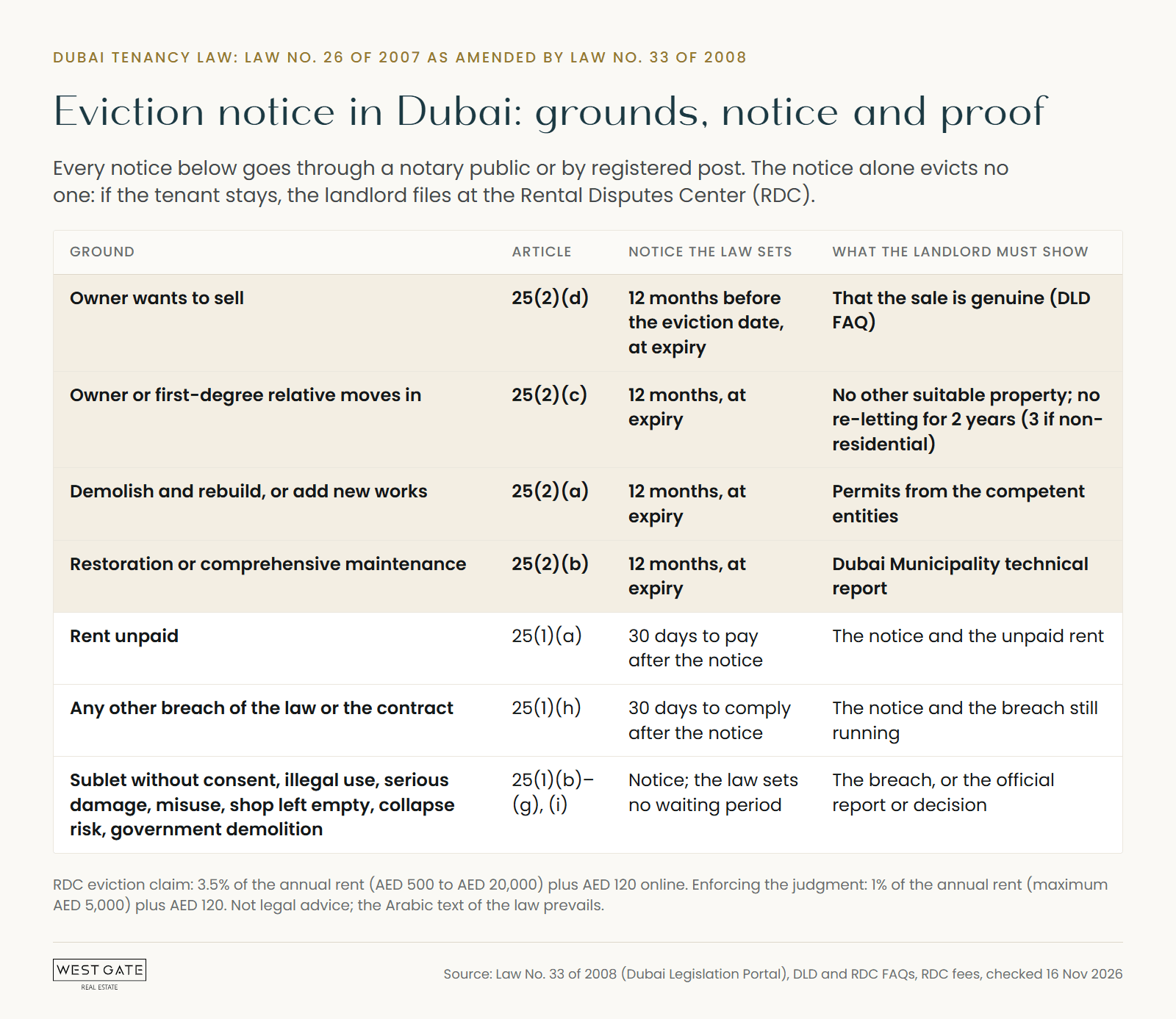
Eviction notice Dubai rules at a glance
Each ground in Article 25, its notice, the landlord's proof and the tenant's checks, from the law and the DLD and RDC guidance (checked 16 November 2026).
| Ground | Article | Notice the law sets | What the landlord must show | What the tenant can check |
|---|---|---|---|---|
| Owner wants to sell | 25(2)(d) | At least 12 months before the eviction date; lease at expiry | That the sale is genuine (DLD) | Method, dates, and whether a sale is really under way |
| Owner or a first-degree relative will live there | 25(2)(c) | At least 12 months; lease at expiry | No other suitable property | Compensation if it is re-let within 2 years (3 if non-residential), Article 26 |
| Demolish and rebuild, or add works that stop the tenant using it | 25(2)(a) | At least 12 months; lease at expiry | Permits from the competent entities | First refusal to return, taken up within 30 days of notice, Article 29 |
| Restoration or comprehensive maintenance that can't be done with the tenant inside | 25(2)(b) | At least 12 months; lease at expiry | A Dubai Municipality technical report | The report; first refusal to return, Article 29 |
| Rent unpaid | 25(1)(a) | 30 days to pay after the notice, unless agreed otherwise | The notice and the unpaid rent | Pay in full within the 30 days and keep a receipt |
| Any other breach of the law or the contract | 25(1)(h) | 30 days to comply after the notice | The notice and a breach still running | Put it right within the 30 days and keep proof |
| Sublet without consent, illegal use, serious damage, use for another purpose, a commercial unit left empty, collapse risk, government-ordered demolition | 25(1)(b) to (g), (i) | A notice; the law sets no waiting period | The breach, or the Dubai Municipality report or government decision | Whether the facts are right; defend the claim at the RDC |
When can a landlord give a 12-month eviction notice?
Only to end the lease at expiry, and only for one of the four reasons in Article 25(2): the owner wants to sell; the owner or a first-degree relative will use the property and the owner has no other suitable one; demolition and rebuilding with permits; or restoration or comprehensive maintenance that a Dubai Municipality technical report says can't be done with the tenant inside.
The notice must state the reason and reach the tenant at least 12 months before the eviction date. The DLD measures the 12 months from the notification, so allow time for delivery. Older guides that quote 90 days use the original 2007 text, replaced in 2008.
For own use, the DLD says owning another property doesn't defeat the claim if only this one suits the purpose. If the RDC grants possession, the owner can't let the property to anyone else for two years (residential) or three (non-residential) unless the RDC sets a shorter period, or the former tenant can claim fair compensation (Article 26). The law doesn't define first-degree relative, so confirm who qualifies before serving the notice.
For a sale, the DLD says the landlord must show the sale is serious, without listing the documents. After demolition or renovation, the former tenant has first refusal to return, at a rent set under the law's rent rules, and must take it up within 30 days of the landlord's notification (Article 29).
Can a landlord refuse to renew a lease without a reason?
No. Article 25(2) lets a landlord seek eviction at the end of a lease only if one of its four grounds applies, with 12 months' notice. What a landlord can do at renewal is propose new terms, including a rent change within the RERA rules, with at least 90 days' notice before the lease expires (Article 14); if the two sides can't agree, the RDC can set a fair rent (Article 13).
If a tenant stays on after expiry and the landlord doesn't object, the lease renews for the same term or one year, whichever is shorter, on the same terms (Article 6). Our RERA rent increase calculator guide and rent decrease guide cover what the rent can do at renewal.
Can a landlord evict a tenant before the lease ends?
Only in the nine cases in Article 25(1), each after a notice through a notary public or registered post. The common two are rent still unpaid 30 days after a notice to pay, unless the parties agreed otherwise, and any other breach of the law or the contract not put right within 30 days of a notice to comply.
The other seven need a notice too, but the law sets no waiting period: subletting without written consent (the subtenant is evicted as well), illegal or immoral use, a commercial unit left empty without reason for 30 days in a row or 90 in a year (unless agreed otherwise), dangerous changes or deliberate or grossly negligent damage, use for another purpose or against planning rules, a collapse risk proved by a Dubai Municipality report, and government-ordered demolition. A sale isn't one of them: it doesn't end a fixed-term lease (Article 28).
Building safety orders: a separate three-month rule Under Law No. 3 of 2026 on the quality and safety of buildings (issued 27 February 2026), where an approved technical report says repairs are needed before a building can get its quality and safety certificate, occupants must vacate within three months of the approval. If they don't, the RDC hears the owner's eviction claim on a summary basis; occupants have priority to return afterwards at the same rent unless agreed otherwise (Articles 12 and 15). Approved demolitions follow the tenancy law's rules.
How do you serve an eviction notice in Dubai?
Through a notary public or by registered post; Article 25 names no other channel. Dubai Courts' Legal Notices service attests a notice online if you hold a valid Emirates ID, or in person with a passport only, for AED 200 plus AED 100 per signature for data entry. By post, use registered mail and keep the receipt and the acknowledgement of delivery.
- Check the ground and the dates against the lease. For a 12-month notice, pick an eviction date at least 12 months after the tenant will receive it and not before the lease ends.
- Write the notice. Both names, the property and its Ejari contract number, the ground and its article, the eviction date (or, for unpaid rent, the amount and the 30 days to pay), and your signature. The DLD asks for the reason and the date; the rest lets the RDC match the notice to the lease.
- Prepare Arabic. The RDC accepts documents only in Arabic or legally translated, and Dubai Courts asks for a legal translation certified by the Ministry of Justice for documents not in Arabic.
- Serve it. Dubai Courts' notary (online or at a service centre), a licensed private notary, or Emirates Post registered mail.
- Keep the proof. The RDC asks for the notarised notice with the notification officer's report, or the registered-post notice with the acknowledgement of receipt.
- Diary the dates. 30 days for a notice to pay or comply; the eviction date for a 12-month notice. Only then can the eviction be filed.
The notary fee schedule (Executive Council Resolution No. 72 of 2025, in force since 15 September 2025) sets the same AED 200 and AED 100; licensed private notaries charge fees Dubai Courts set from 2 January 2026. We found no published charge for delivering a notarised notice and no Emirates Post rate for registered mail, so ask for the total before you pay.
What does it cost to evict a tenant in Dubai?
About AED 300 to have one landlord's notice attested at a Dubai Courts notary. If the tenant doesn't leave, the RDC eviction claim costs 3.5% of the annual rent, at least AED 500 and at most AED 20,000, plus AED 120 online, and enforcing the judgment costs 1% of the annual rent, up to AED 5,000, plus AED 120.
| خطوة | Official fee (checked 16 November 2026) | Example: annual rent AED 120,000 |
|---|---|---|
| Notice attested by a Dubai Courts notary | AED 200 + AED 100 per signature | درهم إماراتي 300 |
| Notice by registered post | Emirates Post's rate (not published online) | Ask at the counter |
| RDC eviction claim, online | 3.5% of annual rent (min AED 500, max AED 20,000) + AED 120 | 4,320 درهم إماراتي |
| Power of attorney, if a representative files | درهم إماراتي 25 | درهم إماراتي 25 |
| Filing at a Real Estate Services Trustee centre instead | + AED 130 + VAT | + AED 136.50 |
| Enforcing the eviction judgment | 1% of annual rent (max AED 5,000) + AED 120 | درهم إماراتي 1,320 |
| Each electronic request during enforcement | 20 درهم إماراتي | 20 درهم إماراتي |
The AED 120 is the RDC's AED 100 process-service fee plus AED 10 knowledge and AED 10 innovation fees; the example totals are our arithmetic from the RDC's schedule. Eviction judgments can be appealed whatever the rent, within 15 days. Our Rental Disputes Center guide covers accounts, hearings, conciliation and appeals.
What should a tenant do after receiving an eviction notice?
Check it before you start packing: how it was served, the reason and the dates. A 12-month notice has to come through a notary public or registered post, give one of the four reasons and set an eviction date at least 12 months after you received it. Keep paying rent meanwhile: a pending eviction claim doesn't pause it (Article 31).
- Method: a notary public or registered post. A call, an email or a WhatsApp message isn't the notice Article 25 requires.
- Reason: one of the grounds in the table above, with the proof the law asks for.
- Dates: at least 12 months from delivery and not before the lease ends; for unpaid rent, 30 days to pay.
- Your home: the landlord may not cut services or disturb your use of the property (Article 34). Report it to the police station for the area, and ask the RDC's urgent matters judge for a petition order to restore electricity and water.
- Settle or defend: agree a move-out date or terms if that suits you (the DLD says an agreed ending can be documented at a Dubai Courts notary or through RDC conciliation), or defend the claim at the RDC if the landlord files. During enforcement you can ask online for a later eviction date.
- Afterwards: if the owner re-lets a home within two years of an own-use eviction (three for non-residential), you can claim fair compensation (Article 26); after demolition or renovation you have first refusal to return (Article 29). Moving out? See our guide to Ejari cancellation.
What happens to an eviction notice if the property is sold?
The lease survives the sale: a change of owner doesn't affect a fixed-term lease (Article 28), and the buyer becomes the landlord. The RDC's guidance covers an owner who sells during a 12-month own-use notice: the sale is allowed, but a new owner who wants the property vacated must send a legal notice in accordance with the law.
So a buyer who wants vacant possession shouldn't assume the seller's notice carries over; make vacancy a condition of the sale and take legal advice. Our guide to buying or selling a tenanted property covers the three routes.
Where is the law unclear, and when should you get advice?
When the dates don't line up with the lease, when the notice went by any route other than a notary public or registered post, and when the ground rests on proof the DLD doesn't spell out. The RDC doesn't give legal advice, but its free Virtual Judge service explains each side's rights before you file; for a contested eviction, speak to a UAE-licensed lawyer.
- Dates mid-lease: the law allows the claim at expiry and sets at least 12 months before the eviction date. It doesn't say what happens when 12 months from delivery lands part-way through a renewed term, and we found no official guidance on it.
- Courier delivery: one RDC answer treats a notice sent by a courier company as enough to file on, but the law and the RDC's filing page name only a notary public or registered post. Use one of those two.
- Proof: the DLD asks for proof that a sale is serious and, for own use, that no other property suits, but lists no documents; the RDC weighs the evidence case by case.
- Translations: the English texts of these laws are translations, and the Arabic text prevails.
This guide is general information from the official sources below, not legal advice. Landlords who would rather not handle renewals, notices and tenant questions themselves can talk to our property management team; tenants planning a move can browse our homes for rent.
الأسئلة المتكررة
How much notice does a landlord need to give to evict a tenant in Dubai?
At least 12 months before the eviction date to end a lease at expiry for a sale, own or family use, demolition or major renovation (Article 25(2) of Law No. 26 of 2007, as amended). During the lease, unpaid rent or another breach needs a notice giving 30 days to pay or comply. All of these go through a notary public or registered post.
Is the eviction notice period in Dubai 90 days?
No. The 90-day notice in Article 14 is for changing lease terms, such as the rent, at renewal. Ending a lease at expiry needs 12 months' notice for one of four reasons; the 90-day eviction notice in the original 2007 law was replaced in 2008.
Can an eviction notice be sent by email or WhatsApp in Dubai?
Not as the notice Article 25 requires: it names a notary public or registered post, and the RDC asks for the notary's notification report or the postal acknowledgement when an eviction is filed. Emails and WhatsApp messages can still count as evidence once both sides acknowledge them in the case.
How much does an eviction notice cost in Dubai?
At a Dubai Courts notary, AED 200 to attest a legal notice plus AED 100 per signature for data entry, so AED 300 for one landlord (checked 16 November 2026). Private notaries charge fees set by Dubai Courts, and registered post costs Emirates Post's rate.
Can a landlord evict a tenant to sell the property in Dubai?
Yes, at the end of the lease, with at least 12 months' notice by notary public or registered post stating the sale as the reason (Article 25(2)(d)), and the DLD says the sale must be serious. Selling on its own doesn't end a fixed-term lease (Article 28).
What happens if a tenant doesn't leave after an eviction notice?
Nothing automatic. The landlord files an eviction claim at the RDC (3.5% of the annual rent, AED 500 to AED 20,000, plus AED 120 online) and, after a judgment, an execution file to enforce it. The tenant keeps paying rent throughout (Article 31), and the landlord may not cut services or otherwise disturb the tenant (Article 34).
مصادر
- Law No. 33 of 2008 Amending Law No. 26 of 2007 (Dubai Legislation Portal): Articles 2, 13, 14, 25, 26 and 29 as amended
- Law No. 26 of 2007 Regulating the Relationship between Landlords and Tenants (Dubai Legislation Portal): Articles 6, 7, 28, 31, 34 and 35
- Real estate legislation compilation (RDC, PDF): the original 2007 text of Articles 25 and 26 (90 days, one year)
- RDC: Register First Instance Lawsuit (Rental): eviction claim documents, Arabic rule and fees
- RDC: Frequently asked questions: enforcement fees, appeals, sale during a notice, messages as evidence, later eviction dates, cut services
- RDC: Virtual Judge and Register a Petition Order
- Dubai Land Department: Frequently asked questions: conditions for own-use, sale and demolition evictions, the 13 cases, documenting an agreed ending
- Dubai Courts: Legal Notices: online attestation, Emirates ID rule, translations, AED 200 + AED 100
- Executive Council Resolution No. 72 of 2025 (Dubai Legislation Portal): notary fees, in force 15 September 2025
- Dubai Media Office, 29 December 2025: private notary fees from 2 January 2026
- Law No. 3 of 2026 Concerning the Quality and Safety of Buildings (Dubai Legislation Portal): Articles 12 and 15
Checked on 16 November 2026.