Buying property in Dubai for Indians works as it does for any foreign buyer: Dubai's property registration law lets non-UAE nationals own freehold homes in the areas the Ruler designates, and the Dubai Land Department (DLD) registers the sale on your passport. The Indian side is what needs planning. A resident of India pays through the Reserve Bank of India's (RBI) Liberalised Remittance Scheme (LRS), capped at USD 250,000 per person per financial year, and the bank collects 20% Tax Collected at Source (TCS) on remittances above INR 10 lakh in the year. An Indian living and working in the UAE, a non-resident Indian (NRI), doesn't use the LRS at all.
- Report it every year: a resident of India lists the Dubai home in Schedule FA of the Indian income tax return for every year they hold it.
- Not tax advice: the rules below are as RBI, India's Income Tax Department and DLD published them on 16 November 2026. Have a chartered accountant (CA) check your own case before you send money.
Can Indians buy property in Dubai?
Yes. Dubai's Law No. 7 of 2006 on real property registration lets non-UAE nationals, with the Ruler's approval, own freehold property without time limit in the areas he designates, or hold a usufruct or lease of up to 99 years. Indian citizens buy on those terms like any other foreign buyer, whether they live in India or in the UAE.
DLD's sale registration accepts a valid passport from non-resident foreigners, so you don't need a UAE residence visa to buy. DLD's Annual Report 2024, published on 28 October 2025, doesn't rank buyers by nationality: it puts investors from Asia at about AED 301.9 billion, about 58% of the AED 521.6 billion invested in 2024, and names India among the significant contributors alongside China, Pakistan and the Gulf states.
Prices are set in dirhams, and the dirham is fixed to the US dollar at AED 3.6725, so a Dubai home's rupee price moves with the dollar–rupee rate. Before you pay a deposit, check the advert's permit with our guide to the Trakheesi permit check.
Buying property in Dubai for Indians: which rules apply to you?
It depends on where you live under India's foreign exchange and tax rules. A resident of India sends money under the LRS, carries TCS on remittances above INR 10 lakh and declares the home in Schedule FA. An NRI working in the UAE pays from money earned abroad, with no LRS limit or TCS, and doesn't file Schedule FA while non-resident.
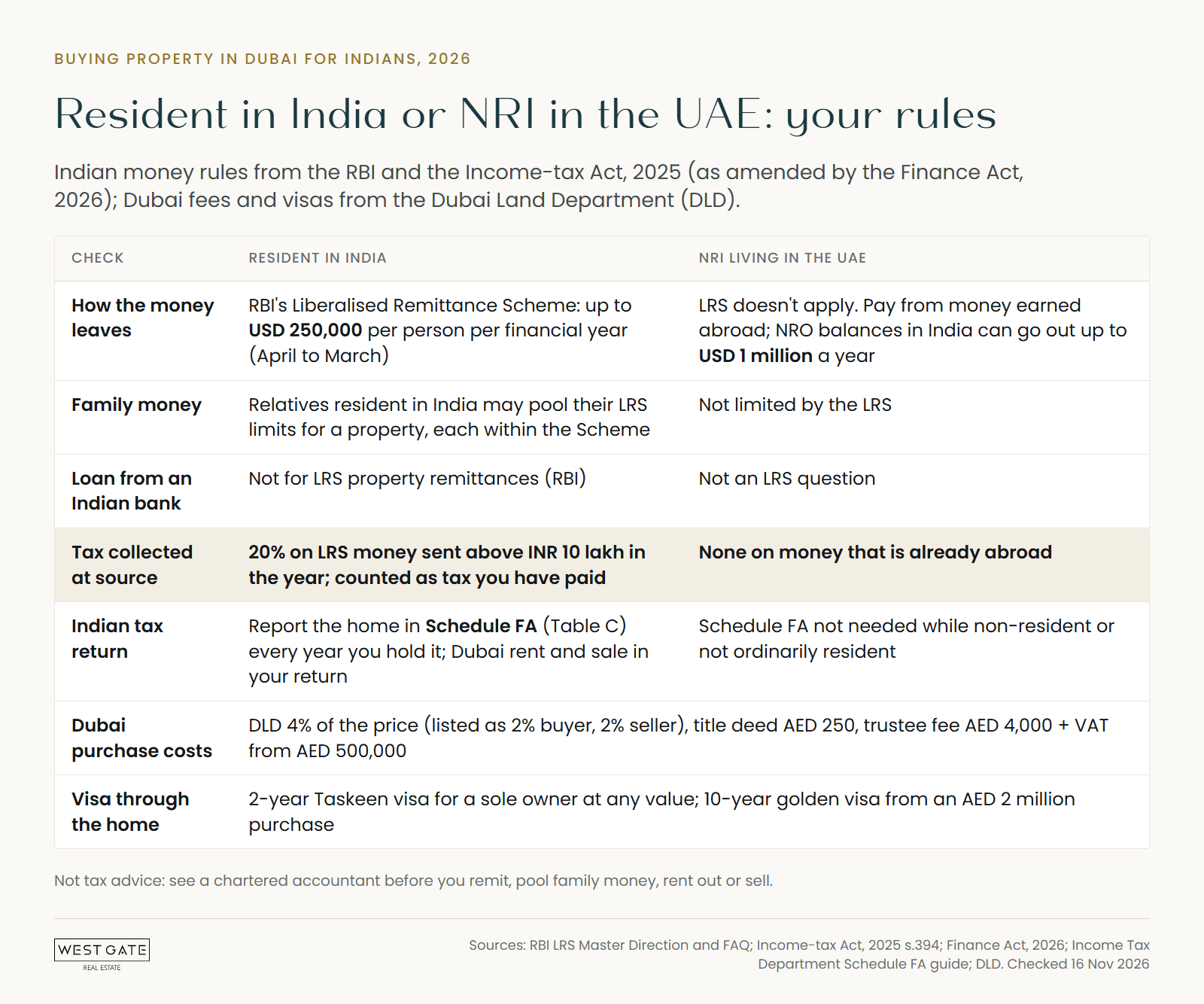
| Check | Resident in India | NRI living in the UAE |
|---|---|---|
| How the money leaves India | RBI's LRS: up to USD 250,000 per person per financial year (April to March) | The LRS doesn't apply; pay from money earned abroad. NRO balances in India can go out up to USD 1 million a year |
| Family money | Relatives resident in India may pool their LRS limits for a property, each within the Scheme | Not limited by the LRS |
| Loan from an Indian bank | Not for LRS property remittances (RBI) | Not an LRS question |
| Tax collected at source | 20% on LRS remittances above INR 10 lakh in the financial year, counted as tax you have paid | None on money that is already abroad |
| Indian tax return | Report the home in Schedule FA (Table C) every year you hold it; Dubai rent and any sale go in your return | Schedule FA not needed while non-resident or not ordinarily resident |
| Dubai purchase costs | DLD 4% of the price (listed as 2% buyer, 2% seller), title deed AED 250, trustee fee AED 4,000 + VAT from AED 500,000 | The same |
| Visa through the home | 2-year Taskeen visa for a sole owner at any value; 10-year golden visa from an AED 2 million purchase | The same |
How much money can a resident Indian send to buy property in Dubai?
Up to USD 250,000 per person in each financial year (April to March) under the RBI's LRS, which allows buying property abroad. That is about AED 918,000 at the dirham's fixed dollar rate. The same limit covers everything else you send under the LRS that year, such as travel, gifts, study costs and overseas investments.
- Family pooling: RBI lets relatives who are resident in India combine their LRS remittances for a property bought from a person resident outside India, as long as each of them complies with the Scheme. Two relatives can send up to USD 500,000, about AED 1.84 million, in one financial year.
- No Indian loan for it: RBI's Master Direction says banks should not extend credit facilities to resident individuals to fund capital account remittances under the LRS, so the money for a property has to be your own.
- Paperwork: your PAN is mandatory, you fill in Form A2 for the remittance, and capital account remittances go through one bank branch you designate. RBI's FAQ expects the account to have been held for a year, or extra checks on the source of funds for a new customer.
- One limit a year: once you have sent USD 250,000 in a financial year, RBI allows no further LRS remittances that year, even if money comes back to India.
- Unused money comes home: foreign exchange you don't use or reinvest has to be brought back and surrendered to a bank in India within 180 days.
How much TCS do you pay on money sent for Dubai property?
20% on LRS remittances above INR 10 lakh in the financial year, collected by your bank when it sends the money. The rate is in section 394 of the Income-tax Act, 2025. The Finance Act, 2026 cut the rate for education and medical remittances to 2% from 1 April 2026, but left the 20% rate for property and other purposes unchanged.
TCS is not a fee you lose. Under section 390(5) of the Act, tax collected from you and paid to the government counts as tax paid on your behalf, and you claim credit for it in your return against the tax you owe for the year. It still leaves your account first: send INR 2 crore in a year and close to INR 40 lakh of it goes as TCS. Your bank issues a certificate showing what it collected.
Can you pay for an off-plan property in instalments under the LRS?
Yes. RBI sets no limit on how often you remit, so each instalment can go when it falls due, and each one counts against the limit of the financial year in which you send it. A payment plan that runs over several years spreads across several USD 250,000 limits, which reset every 1 April, and TCS applies in each year you pass INR 10 lakh.
On the Dubai side, the developer registers an off-plan sale in DLD's provisional register (Oqood) within 90 days of the sale and purchase agreement being signed. DLD lists the fee as 2% from each side, and some developers pay all or part of the buyer's share: see our guide to the DLD waiver. Before you commit, check the project's progress and escrow details with our guide to off-plan project status in Dubai.
Sign in December 2026, for example, and the booking payment comes out of your 2026–27 limit (to 31 March 2027); instalments from April 2027 count against the 2027–28 limit. Ask your CA how to show the payments in Schedule FA while the home is being built.
What changes for an NRI living in the UAE?
The LRS doesn't apply to you. RBI describes an NRI as a person resident outside India who is an Indian citizen, and the LRS is for residents of India, so you pay from money you earn and hold abroad, with no USD 250,000 limit and no TCS. Money in an NRO account in India can be sent abroad up to USD 1 million per financial year, on RBI's conditions.
Your Indian tax status is set mainly by days in India: under section 6 of the Income-tax Act, 2025, you are resident if you spend 182 days or more there in the year, among other tests. Income from outside India, such as Dubai rent, is taxed in India only if you are resident and ordinarily resident. A citizen with more than INR 15 lakh of Indian income who isn't liable to tax anywhere can be deemed resident (not ordinarily resident): one for your CA.
If you later move back to India, you can keep the Dubai home: section 6(4) of the Foreign Exchange Management Act, 1999 (FEMA) lets a resident hold foreign property bought while non-resident. From the first year you are resident and ordinarily resident, it goes in Schedule FA. NRIs on a UAE salary can also borrow from a UAE bank; our guide to mortgage pre-approval in the UAE covers what banks ask for.
Do you have to declare Dubai property in your Indian tax return?
Yes, if you are resident and ordinarily resident in India. The Income Tax Department's guide says residents must disclose all foreign assets in Schedule FA, with immovable property in Table C: what it cost, the income from it and the part taxable in India. Non-residents and those not ordinarily resident don't fill in Schedule FA.
- Which form: ITR-1 and ITR-4 have no Schedule FA, so a resident with foreign assets has to use a return form that does.
- Which period: assets held at any time in the calendar year to 31 December; for assessment year 2025–26 that was 1 January to 31 December 2024.
- Even with no taxable income: section 263 of the Income-tax Act, 2025 requires a resident (other than not ordinarily resident) who holds any asset outside India during the tax year to file a return.
- Rent and sale: income from the property goes in Schedule FSI as well as in the normal computation of your income.
- Rupee values: convert at the State Bank of India's telegraphic transfer buying rate on the relevant date.
Leaving it out is costly. The Black Money (Undisclosed Foreign Income and Assets) and Imposition of Tax Act, 2015 provides for penalties and, for wilful non-disclosure, prosecution. The Finance Act, 2026 removed prosecution for undisclosed foreign assets worth up to INR 20 lakh in total, but that relief excludes immovable property, so a Dubai home always has to be reported.
What does buying cost on the Dubai side?
DLD lists a registration fee of 4% of the price, shown as 2% from the buyer and 2% from the seller, plus AED 250 for the title deed and a registration trustee fee of AED 4,000 plus VAT on sales of AED 500,000 or more (AED 2,000 plus VAT below that). Check your contract for which side pays the 4%: on an AED 1.5 million flat, it is AED 60,000.
| DLD item | Ready home (title deed) | Off-plan (Oqood) |
|---|---|---|
| Registration fee | 2% buyer + 2% seller | 2% purchaser + 2% seller |
| Title document | AED 250 electronic title deed | Provisional registration e-certificate |
| Trustee centre | AED 4,000 + VAT from AED 500,000; AED 2,000 + VAT below | Registered by the developer on the Oqood portal |
| Documents | Passport for a buyer living abroad; developer's no-objection certificate (e-NOC) in freehold areas | Copy of the signed sale and purchase agreement; passport copy for a non-resident |
| Time | About 20 minutes at the trustee | Registered within 90 days of signing |
DLD also lists small map, knowledge and innovation fees. Broker commission isn't a DLD fee, so agree it in writing. On a resale, the seller obtains the NOC from the developer. For prices by community, see our average price per sq ft in Dubai from 2026 DLD sales. If you live in India and are thinking of a UAE mortgage, ask your bank and CA first how India's foreign exchange rules treat borrowing abroad.
Does buying property in Dubai give you a UAE visa?
It can. DLD's 2-year Taskeen investor visa is open to a sole owner whatever the property is worth, and to a co-owner whose share is worth at least AED 400,000; DLD lists the fee at AED 10,212.50. A purchase value of AED 2 million or more opens the 10-year golden visa, listed at AED 9,884.75.
For a resident of India, the LRS shapes the route: one person can send about AED 918,000 a year, so paying AED 2 million in a single financial year takes pooled family remittances, while a payment plan spreads it over several years. DLD's golden visa terms accept a mortgaged home with a bank letter, and the applicant must be inside the UAE. Our guide to the property investor visa in Dubai has the fees and documents.
What are the steps for a resident Indian buying in Dubai?
- Confirm your status under FEMA and Indian tax (resident, not ordinarily resident or non-resident) for each financial year you will pay in.
- Choose the home and check it: the advert's Trakheesi permit, and DLD's project status for an off-plan unit.
- Plan the money by financial year: USD 250,000 per person, relatives pooling if needed, TCS above INR 10 lakh and no Indian bank loan for the remittance.
- Remit from your own bank: PAN, Form A2 and your designated branch. Keep the bank's TCS certificate for your return.
- Sign and register with DLD: a ready home at a registration trustee with your passport, which issues the electronic title deed; an off-plan unit through the developer on Oqood within 90 days.
- Bring back anything unused within 180 days, unless you reinvest it.
- Report it every year in Schedule FA, with any rent or sale in your return.
When should you see a chartered accountant?
Before your first remittance, and again whenever something changes. This page sets out the rules as RBI, the Income Tax Department and DLD publish them; it isn't tax advice. A CA can confirm your residential status, how much TCS you will carry and how it will be credited, and how to report the property and its income each year.
- You are pooling money with relatives, buying jointly or borrowing, in India or in the UAE.
- You will rent the home out or sell it, which brings Indian tax on the rent or the gain if you are resident and ordinarily resident.
- You are moving between India and the UAE, or hold a foreign asset you didn't report in an earlier return.
Checked on 16 November 2026 We update this page when RBI, the Income Tax Department or DLD change the LRS limit, the TCS rates or the fees.
Frequently asked questions
Can an Indian citizen buy property in Dubai?
Yes. Dubai lets non-UAE nationals own freehold property in the areas the Ruler designates, and DLD registers a buyer who lives outside the UAE on a valid passport. You don't need a UAE residence visa to buy.
How much money can I send from India to buy property in Dubai?
Up to USD 250,000 per person per financial year (April to March) under the RBI's Liberalised Remittance Scheme, about AED 918,000. Relatives resident in India can pool their limits for a property, each within the Scheme's terms.
What is the TCS on sending money abroad to buy property in 2026–27?
20% on LRS remittances above INR 10 lakh in the financial year, under section 394 of the Income-tax Act, 2025. It counts as tax you have paid, so you claim credit for it in your income tax return.
Can I take a home loan in India to buy property in Dubai?
Not for the remittance. RBI's LRS Master Direction says banks should not extend credit facilities to resident individuals to fund capital account remittances under the Scheme, which include buying property abroad.
Do NRIs in the UAE pay TCS when buying property in Dubai?
Not on money they already hold abroad, because the LRS and its TCS apply to residents of India. An NRI can send money from an NRO account in India up to USD 1 million per financial year, on RBI's conditions.
Do I have to show my Dubai property in my Indian income tax return?
Yes, if you are resident and ordinarily resident in India: it goes in Schedule FA, Table C, for every year you hold it, and you must file a return even without taxable income. Non-residents and those not ordinarily resident don't fill in Schedule FA.
Sources
- RBI: Master Direction, Liberalised Remittance Scheme: limit, property abroad, family pooling, no bank credit, PAN, 180 days (updated 6 September 2024; checked 16 November 2026)
- RBI: FAQ on the Liberalised Remittance Scheme (checked 16 November 2026)
- RBI: FAQ on purchase of immovable property: FEMA section 6(4), NRI definition (checked 16 November 2026)
- RBI: Master Direction, Deposits and Accounts: NRO up to USD 1 million a year (updated 2 September 2026; checked 16 November 2026)
- The Income-tax Act, 2025, Gazette of India: sections 5, 6, 263, 390 and 394 (checked 16 November 2026)
- Finance Bill, 2026, Gazette of India and the Budget memorandum: TCS rates from 1 April 2026 and the Black Money Act relief, enacted in the Finance Act, 2026 (No. 4 of 2026), sections 85 and 160 (checked 16 November 2026)
- Income Tax Department: guide to Schedules FSI, TR and FA (checked 16 November 2026)
- Dubai Legislation Portal: Law No. 7 of 2006: Article 4 (checked 16 November 2026)
- DLD: Property sale registration and initial (off-plan) sale registration: fees and documents (checked 16 November 2026)
- DLD: Taskeen investor visa and golden visa for real estate investors (checked 16 November 2026)
- DLD: Annual Report 2024, published 28 October 2025 (checked 16 November 2026)
Buying from India or from the UAE? Browse our new off-plan projects or talk to an agent about homes, payment plans and the DLD steps, and take this page to your chartered accountant for the Indian side.